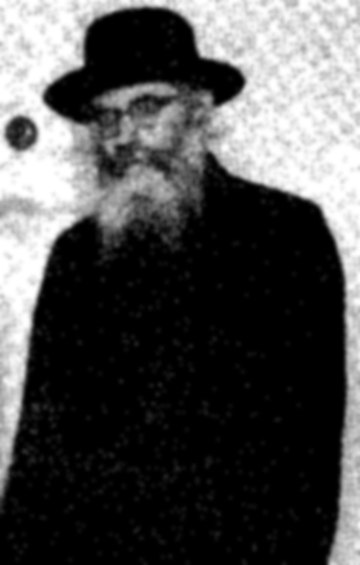
He learned in Tomchei Temimim in Lubavitch in the days of the Rebbe Rashab, where his friends called him “Mordechai der Masmid.” He served as a rav in Russia and Georgia, was exiled to Siberia for spreading Torah, and later was a rav and mashpia in Milan and Melbourne. With the Rebbe's encouragement, he wrote down the stories he had heard and seen in Lubavitch, and they became this sefer.
His lifeFrom the sefer’s own biography of the author, pp. 9–12
Rabbi Chaim Mordechai HaKohen Perlow was born in about 5649 (1889) in the city of Kherson in southern Ukraine. His father, R' Dovid, was one of the Jewish settlers of the area from the time the Tzemach Tzedek founded the farming colonies (“kolonies”) for Jews in southern Ukraine.
Lubavitch: “Mordechai der Masmid”
In 5664 (1903–04) he was accepted into the yeshivah Tomchei Temimim in Lubavitch. There he learned with such tremendous hasmadah that his friends called him “Mordechai der Masmid.” It is told that the Rebbe Rashab personally once told the students of the yeshivah, at a Chassidishe farbrengen, that they should learn what hasmadah means from the bochur Mordechai Perlow.
As a rule he would sit and toil in learning Torah sixteen to eighteen hours a day, mostly in Shas and poskim. His learning bore fruit: he became wonderfully expert in halachah, and to the end of his days he was one of the outstanding poskim and morei hora'ah among the rabbonim of Chabad.
Besides this, following a special instruction from the Rebbe Rashab, he trained himself to review Mishnayos and maamarei Chassidus by heart, until he knew all six orders of the Mishnah, and many maamarei Chassidus, by heart.
Rav in Russia and Georgia
In 5672 (1912) he married Mrs. Sheina Beila, the daughter of the gaon R' Avraham Ber, the rav of the town of Shadeva near Kovno in Lithuania, and moved there.
In 5678 (1918) he returned to Ukraine to serve as rav and moreh hora'ah in the town of Berislav, near Kherson, and remained there until 5679 (1919).
In 5679 he was appointed a maggid shiur in the Tomchei Temimim yeshivah in Kherson. But because of the terrible famine across the whole region, he was forced to leave the country in 5682 (1922). He went to the town of Kulashi in Georgia to serve as moreh hora'ah there, together with his brother-in-law, the gaon and Chassid R' Avraham Levik Slavin, Hy”d. (The two were married to two sisters.)
Some time later he moved from there to a nearby town called Satshili, where he founded a yeshivah and a cheder for the local children, and a mikveh as well.
In 5688 (1928) he moved to the town of Sachkhere to serve as rav and moreh hora'ah. During his years there he worked hard to bring the young people to keep Torah and mitzvos, especially Shabbos and Yom Tov.
The town had a large weaving factory where many Jewish young people worked. When the police saw that many of the Jews had stopped coming to the factory on Shabbos, they understood at once that this was the rav's influence. So they arrested him, and he was held from 5693 (1933) until the winter of 5694 (1934).
Prison and Siberia
When he came back from prison he moved to Kutaisi, in those days the central city of the Jews of Georgia, and there too he worked to spread Torah, until the authorities seized him in 5696 (1936) and sent him to Siberia, to exile and prison for ten years. Years later he told that while in prison he would constantly review Mishnayos and Chassidus by heart, and that it was then he understood the Rebbe Rashab's instruction to him to know Mishnayos and Chassidus by heart. Miraculously, he came back from there after six and a half years of imprisonment.
After the war: Germany and Italy
After the Second World War, in 5706 (1946), he succeeded in leaving Russia, and stayed in the refugee camp in the town of Schwäbisch Hall near Munich, Germany. At that time a Vaad HaRabbonim (council of rabbonim) was founded in Munich to deal with the questions of agunos, gittin, chalitzah and the like that arose after the war. He served on this council together with the gaon R' Dovid HaKohen Shapiro, formerly av beis din of Warsaw; the gaon R' Shmuel Snieg (of Yeshivas Chachmei Lublin); and Rabbi Goldman of the town of Krasna. Based on the rulings they issued then, he wrote the sefer “Get L'Maaseh,” which was printed later, in 5730 (1970).
While in the refugee camp he also worked to build a mikveh, and to bring Jews closer to their Father in Heaven in general, by encouraging Shabbos observance and the like.
In 5709 (1949) he moved to Milan, Italy, to serve as rav of the “Ohel Yaakov” shul. There too he worked to build a mikveh, “bor al gabei bor,” according to the takanah of the Rebbe Rashab. This was, it seems, the first time a mikveh following this takanah was built outside Rostov. While there he received many letters of encouragement and detailed instructions from the Rebbe about bringing Jews closer to Torah and mitzvos and to the ways of Chassidus; they are printed in the Rebbe's Igros Kodesh.
Melbourne
In 5719 (1959) he moved to Melbourne, Australia, to be near his only son and family. There too he served as rav and moreh hora'ah, and at the same time he was mashpia in Chassidus in the yeshivah “Ohalei Yosef Yitzchak.” He was a living example of a rav and Chassid of the old generation.
In 5722 (1962) he was inspired to put into writing the stories he had heard in his youth. This is the sefer “Likkutei Sippurim.” For this he received constant encouragement from the Rebbe, until it was published in 5726 (1966).
In 5725 (1965) the Rebbe received the sefer before it was bound. At the Yud Shevat farbrengen the Rebbe mentioned having just received the pages of a book of stories by Rabbi Chaim Mordechai Perlow, and retold one of the stories in the book (the Chassidim section, story 18; page 314 in the new edition).
In 5727 (1967) the Rebbe sent the first group of talmidim-shluchim to learn in the Tomchei Temimim yeshivah in Melbourne. (This was the first time that talmidim were sent from 770 to learn in a branch of Tomchei Temimim in Australia.) While this group was in Melbourne, the author farbrenged with them many times, and shared with them the delight of words of Torah and Chassidus.
He passed away on Yom Kippur 5738 (1977), and is buried in Melbourne, Australia.
In his own wordsThe author’s introduction to Likkutei Sippurim, pp. 13–17
My friends and dear ones among Anash, may they live and be well, pressed me hard, and especially my friend the gaon and Chassid R' Yitzchak Dovid Groner, to write down and preserve as a remembrance the stories and matters that I heard, and also saw, “when the lamp shone over my head” (Iyov 29:3). That was the time I was in Lubavitch and merited to learn in the yeshivah Tomchei Temimim, from the beginning of 5664 until the middle of Adar I, 5673 (1903–1913).
The truth is, as I know in my own soul, that I am no writer. I told our friends of Anash so several times: are there not enough people who write down stories and matters from all different times? But they held to one thing: that my stories are especially exact. So I had to keep the saying of our Sages (Shabbos 118b): “Rabbi Yossi said: I know of myself that I am not a Kohen; but if my friends tell me, ‘Go up to the duchan,’ I go up.” And I set aside my own opinion for the opinion of my friends and dear ones.
Most of the stories that will, with Hashem's help, be recorded here (apart from those I merited to see with my own eyes) I heard from the mashpia who was in Lubavitch at that time, the Chassid R' Shmuel Gronem Esterman. He settled in Lubavitch permanently in 5665 (1905), after the passing of the Chassid R' Shmuel Betzalel (the Rashbatz), who passed away in the summer of 5665 or 5664. Before that, R' Shmuel Gronem was mashpia in the town of Zhembin, where there was a branch of the Lubavitch yeshivah Tomchei Temimim for especially gifted bochurim, who were sent there to be under his influence and guidance.
R' Shmuel Gronem was a disciple and “mekabel” of the gaon and Chassid R' Avraham of Korenitz, who was rav in Zhembin and was one of the great and famous Chassidim of the Tzemach Tzedek. Besides his greatness in avodah and in the teachings of Chassidus, R' Avraham was also very great in nigleh, one of the great and famous rabbonim of his time, and also a tremendous masmid. It is told that once, when he came to the Tzemach Tzedek, the Tzemach Tzedek asked him what he had learned over a certain period of time. He answered: so-and-so much Gemara and poskim, and so on. But he did not say even half of what he had really learned in that time, probably so as not to praise himself. And the Tzemach Tzedek said: “A pnim, mein Avremke iz a masmid” (“It seems my Avremke is a masmid”). (This I did not hear from R' Shmuel Gronem; it was told this way in Lubavitch.)
R' Shmuel Gronem was a true and inward “mekabel.” From R' Avraham he received not only the matters and stories he heard; the main thing he received from him was the heart's longing, the precious taste (“dem geshmak”) of Chassidus, which cannot be put into speech or even into writing, and which stands forever like engraved letters. But here we come only to record, with Hashem's help, as a remembrance, what I heard from him and from other elder Chassidim who were in Lubavitch then, and also the little that I merited to see with my own eyes.
The truth is that, besides the fact that it is more than fifty years since I heard these stories, many hardships have passed over me since then: prison, and exile to hard labor for close to six years (and captivity includes every hardship), and more and more beyond telling. And here too my sins caused it: I fell under an automobile (a car), and both my legs were broken, Heaven save us. This was on 13 Tishrei 5721 (1960). Through Hashem's kindness, “for His mercies have not ended,” and in the merit of the one whose hilula is that day, the Rebbe Maharash, and in the merit of all the tzaddikim, and, l'havdil, may they have long and good lives, the tzaddikim of our day, I merited to get up and be counted among the living once more. But all these things cause forgetting. I was never distinguished by a good memory, and I had no written notes from before, so I must now record only what is written in my memory. Without doubt, what was forgotten over the years, for all these reasons, is far, far more than what will be recorded here. Alas for what is lost.
Still, I hope for Hashem's help, that the few matters written in my memory, which will now be written down with Hashem's help, are not confused, and are exact, with Hashem's help. Blessed is the One Who grants man understanding, Who granted me too a very small measure, so as not to mix things up. And I hope for Hashem's help in the future too: that Hashem grant me length of days and years, and a clear mind in good health, free of outside distractions of any kind, so that nothing improper should leave my hands.
The order: at first I wrote with no order at all, just as things came to mind. Afterwards they were arranged in separate sections, as is customary: beginning with the section of the Baal Shem Tov, then the Maggid, then the Alter Rebbe, and so on, and after that the elder Chassidim. After that, as an addition, a few stories are also recorded about the disciples, and the disciples' disciples, of the Baal Shem Tov and the Maggid. These are very few, because I did not hear so many from the elder Chassidim, and surely I have forgotten far more than what is recorded here. To copy now from books of stories was not my wish, and what need would there be, since those are already well known. That is why they are few, and not, Heaven forbid, to lessen their honor.
I must also let it be known that almost right after I finished writing the stories, I received the book of stories of our friend, the Chassid and man of deeds R' Shneur Zalman Duchman [of blessed memory], and a couple of months later I also received the book of our friend, the Chassid and man of deeds R' Refael Nachman HaKohen [of blessed memory]. Had these books reached me before I wrote, quite possibly I would have held back from writing. But I was nearly finished, and I had already received several letters, written with authority, from the Chassid who faithfully serves the public, Rabbi Hodakov [of blessed memory], and in every letter he wrote that I should hurry, as much as I possibly could, to continue and finish.
In the meantime I also received a letter from the Rebbe, with a note in the Rebbe's holy handwriting to continue writing, and specifically in order to print (as will be printed, with Hashem's help, at the front of the book). Afterwards came a second letter, also with some words in the Rebbe's holy handwriting (as will be seen, with Hashem's help). Therefore it became necessary to print.
And so I pray and hope to Hashem that the merit of all the tzaddikim of these stories, and, l'havdil, may they have long and good lives, the tzaddikim of our day, will stand by me in this and in what is to come, and grant me length of days and years together with my household, in good health, and much nachas from our only son and his family, in every detail, among all of Klal Yisrael. Amen, may it be Hashem's will.
I must also let it be known that some of the stories recorded here are also recorded in the books of the Chassidim mentioned above. Only a few of them are in R' Shneur Zalman Duchman's book [of blessed memory]; more are in the book of R' Refael Nachman HaKohen. But they were already written down by me, and I did not erase them, for two reasons. First, not every book reaches every reader. Second, and this is the main reason: it is true that whoever reads will see that it is the same story, but usually there are small differences in the wording and the style, and each one thinks his own version is the more exact. Surely everyone who writes wants to be exact and to write precisely the wording he heard, so I left them exactly as I heard them. But, as I wrote at the beginning, more than fifty years have passed, thank G-d, since I heard them, and “who can know all his errors?” (Tehillim 19:13). If any of my contemporaries and friends should point something out to me, and find things that are not quite exact, I ask that they not hold back from letting me know, and whatever can be corrected, with Hashem's help and bli neder, I will try to correct with all my ability.
The arranger and writer, who awaits Hashem's salvation in the blink of an eye, and to hear good news from all of Klal Yisrael wherever they are; may we merit immediately to teshuvah, and so immediately to the Geulah; and in the merit of all the tzaddikim mentioned here, and, l'havdil, may they have long and good lives, the tzaddikim of our day, may we merit, together with them, to greet Moshiach Tzidkeinu very soon, among all of Klal Yisrael. Amen, may it be Hashem's will.
Chaim Mordechai, son of R' Dovid HaKohen Perlow
(In Lubavitch they called me “Mordechai Chersoner” [Mordechai from Kherson]. The name Chaim was added now. It is a name given because of illness, and it is written first, as explained in Even HaEzer, siman 129. It was added in 5721 (1960), for the reason mentioned above. May Hashem grant long and good life to all of Klal Yisrael wherever they are, and may no pain or harm, Heaven forbid, come to them. Amen. — the author's note)
Many thanks to the honorable brothers, beloved by Hashem and pleasant to people, the sons of R' Zalman Moshe and Shprintza Leah Feiglin, of blessed memory, who helped a great deal with this. At my request they made photostat copies of all these notes, which made it possible for me to send one copy to New York, to our friend the Chassid R' Chaim Mordechai Hodakov [of blessed memory], who brought it in to the Rebbe. After the Rebbe looked them over, the Rebbe graciously agreed to their being published in print, as is written in the Rebbe's holy handwriting together with the letters mentioned above.
May Hashem grant that the merit of all the tzaddikim and holy ones, of blessed memory, protect them, their wives, their sons and their daughters, in body and soul, in every detail, and may they merit to see very soon the complete Geulah through Moshiach Tzidkeinu, together with all of Klal Yisrael as one. Amen, may it be Hashem's will.
Translated into English from the Hebrew of Likkutei Sippurim (first printed 5726; Jerusalem 5762 edition). Years in brackets are added for the reader. The birth year is given in the sefer as approximate.
‹ Back to the videos